There are many digital tools to help orchestra students become better musicians, however, there is still no replacement for practicing one’s instrument in order to become better at it. You have to play the violin in order to become better at violin. You have to go out and swim in order to become better at swimming. You can read up all you want on violin and swimming, and utilize a variety of tech tools to help you, but nothing can replace actual practice when it comes to wanting to be a better musician or athlete.
Beyond the practice-performance aspect of music, one can become a more well-rounded and globally minded musician and music educator through the digital learning environment. Here are some resources I and my students utilized and/or found engaging.
Video Recording
Most of my students, save a few, own phones with video recording capabilities. I always encourage my students to use their phone productively in practice by video recording themselves and immediately watching and listening to the performance for instant feedback. When you hear and see exactly what your problems are, you know the areas that need your attention and focus, and thereby save time and energy. Video recording also simulates a performance, and can help one learn how to deal nervousness and performance anxiety. Knowing that you might also share your video to social media or have to post it for an audition or assessment will most likely prompt you to practice the music multiple times until you are satisfied. Video recording can be stressful, but it can also bring out and showcase your best work, building a sense of pride, confidence, and accomplishment in what you do. Click here for my YouTube channel where I strive to share my very best video recordings of my and my students’ work.
Padlet
Below are two examples of how we use the online collaboration tool Padlet in my orchestra class. It is a great platform to get people who may not be able to meet in-person to interact with each other and to learn from one another. The first example shows how students develop their reflection and constructive criticism skills, watching and critiquing not only their own group’s performance, but also the other groups in our program. The second example shows the Fulbright Inter-School Project between some of my orchestra students and art students in California. Students interacted through pictures, videos, and writing, focusing on the Essential Question: How can our personal rituals, relationships, and restrictions be used to help us deal with issues and take action in the community, in our country, and across the world?
Digital Archives of Hawai‘i
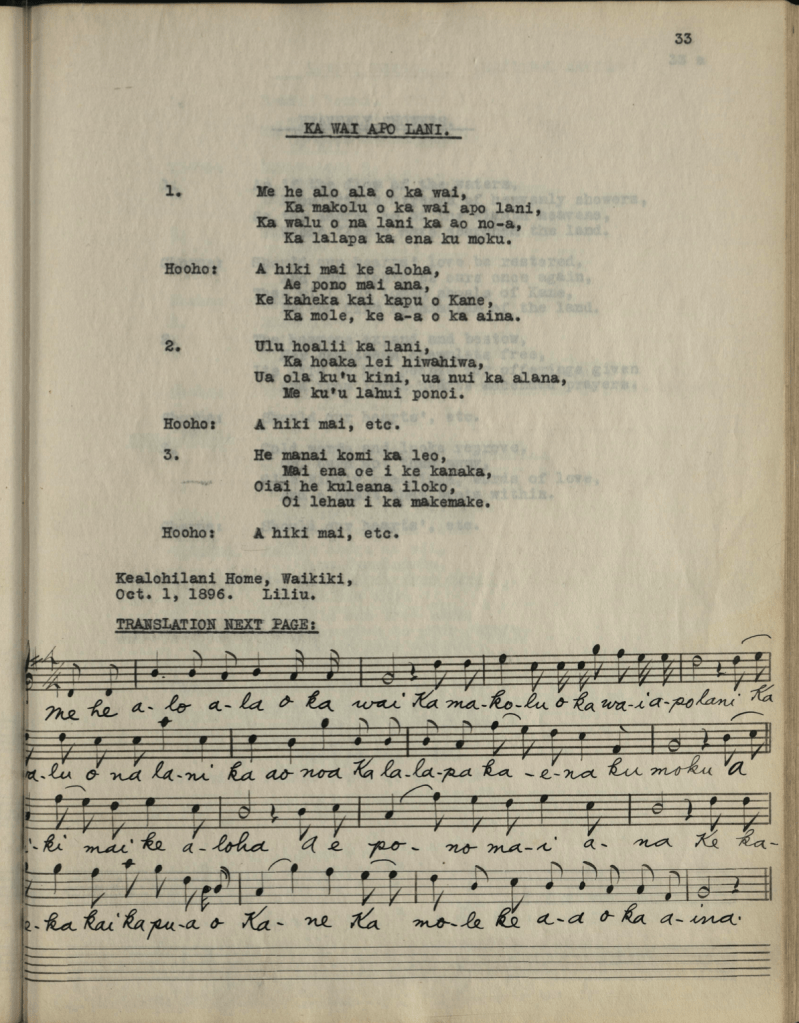
While technological advances have physically preserved manuscripts from history, many institutions are also digitally preserving materials to ensure that future generations from all over the world have access to voices from the past. As a musician and historian, I love looking at manuscripts of works in the composer’s handwriting. Not only does the writing reveal the composer’s personality, but it also provides authenticity, an issue we must constantly deal with in today’s climate of altered images and fake news. For my middle school orchestra students, seeing an original manuscript by Hawaiian composer and royalty Queen Lili‘uokalani drives home the point that the music is created by a people. In order to be more globally minded musicians, we must dig deep into the music by learning about the composer and their cultural-historical background. It’s important for orchestra teachers to program music by local composers to ensure cultural preservation and continuity.
- My arrangement of “Ka Wai ‘Apo Lani” for string orchestra and voice
Radio Garden
Radio Garden provides this description in their “About” statement: “Radio Garden invites you to explore live radio from around the world. By bringing distant voices close, radio connects people and places. From its very beginning, radio signals have crossed borders. Radio makers and listeners have imagined both connecting with distant cultures, as well as re-connecting with people from ‘home’ from thousands of miles away.” This resource can expose one to the musics and languages of cultures around the world, as well as reveal the musical tastes and preferences of cultures around the world. I used it quite frequently prior to going to Uruguay and also while in the country to listen to the preferred musical genres and styles and also to improve my Spanish comprehension skills. I also utilized Radio Garden in my orchestra classroom, hoping to infuse more global awareness in my students listening.
Beer House in Salto, Uruguay. Lots of Latin hits and American pop playing at the bar. The demographic of bar patrons and bar employees skewed younger. It was nice to listen to the music preferred by younger generations.
 Uyehara in Uruguay