With so many aspects that one can focus on during an educational travel experience, it helps to have a Guiding Question to focus your experiences and thoughts. Here is my context or background and my Guiding Question:
CONTEXT:
I am an orchestra teacher, specializing in violin, viola, cello, and bass instruction to middle school students. My primary instruments are violin and viola. While I would like to have field experiences in this specialized area of music, I realize this may not be possible, and have kept my Guiding Question broad, encompassing all performing arts.
GUIDING QUESTION:
To what extent are the performing arts (e.g. music and dance) a part of the school curriculum and community, and what values, competencies, and/or educational standards do these experiences in the performing arts promote?
Reflection:
The Fulbright Teachers for Global Classrooms program is not specifically focused on music or music education, and when I looked through previous participants’ culminating projects, I found one music teacher and one dance educator. I applied to the program, hoping, but not expecting, to experience the music and music education scene somewhere outside of the United States. Honestly, I would just be happy to travel internationally again, and to have an in-depth, rather than touristy, experience of another country’s education system and culture, even if there was no music.
I was elated when accepted and when I learned about my field placement in Uruguay. I quickly started to research the Uruguayan music and music education scene, starting with a search for orchestra, since this is my speciality in music. I was happy to learn about the Filarmónia, a professional symphony orchestra, and checked their performance schedule, hoping they had a concert I could attend. Fortunately, I found a concert by the orchestra during my stay. They were also performing at a venue close to our hotel in Montevideo, so I asked Fulbright if it was possible for me to go. Fulbright was gracious to allow me to attend, and also bought me and the accompanying staff box seat tickets.
It seemed like a full house at the Teatro Solís, one of the oldest theaters in Latin America dedicated to the performing arts. The crowd, mostly of an older demographic, applauded and cheered with enthusiasm, showing their love for the orchestra and the music. The musicians on stage seemed to be a range of ages, showing that younger generations are still choosing to make music as their profession or part of their profession. I asked the accompanying staff if musicians were paid well in Uruguay, and she said no. According to her, most musicians have to take on several jobs in order to live decently. This is a similar situation to orchestral musicians in the United States and in my state of Hawai‘i. We do not go into music for the money, but for the love of the art and for sharing it with others.
The enthusiastic musicians and their audience at the Filarmónia concert, as well as the vibrant and diverse performance schedule offered by the Teatro Solís, clearly reveal Uruguay’s commitment to preserving and perpetuating the performing arts. My Guiding Question’s inquiry into how much music is valued was certainly addressed, and while the value of the performing arts may not necessarily manifest itself through a large monetary compensation to the artists, the existence of performance opportunities and venues where performers can communicate and share their love for art with an attentive and supportive audience, is a big part of what drives performers, in Uruguay and in the United States, to keep the arts alive.
I did not know how much I would actually be sharing my own love for music and the violin in Uruguay. We were asked to prepare a slide presentation that shared about our life and school, but were not given specifics as to anything else we might do. I wasn’t sure if it was worth it to bring a violin, and went back-and-forth constantly about bringing it, as traveling with a musical instrument can be cumbersome and stressful. I decided in the end to bring it because speaking about a violin or sharing videos of myself playing would not have the same impact as the energy that live music brings.
The opening of Mozart’s “Eine Kleine Nachtmusik.” This seemed to be the favorite everywhere I went.
I really should have practiced these pieces more. Yes, I played some incorrect notes.
High school students are often a hard crowd to impress, but they seemed to enjoy and appreciate the music and the learning.
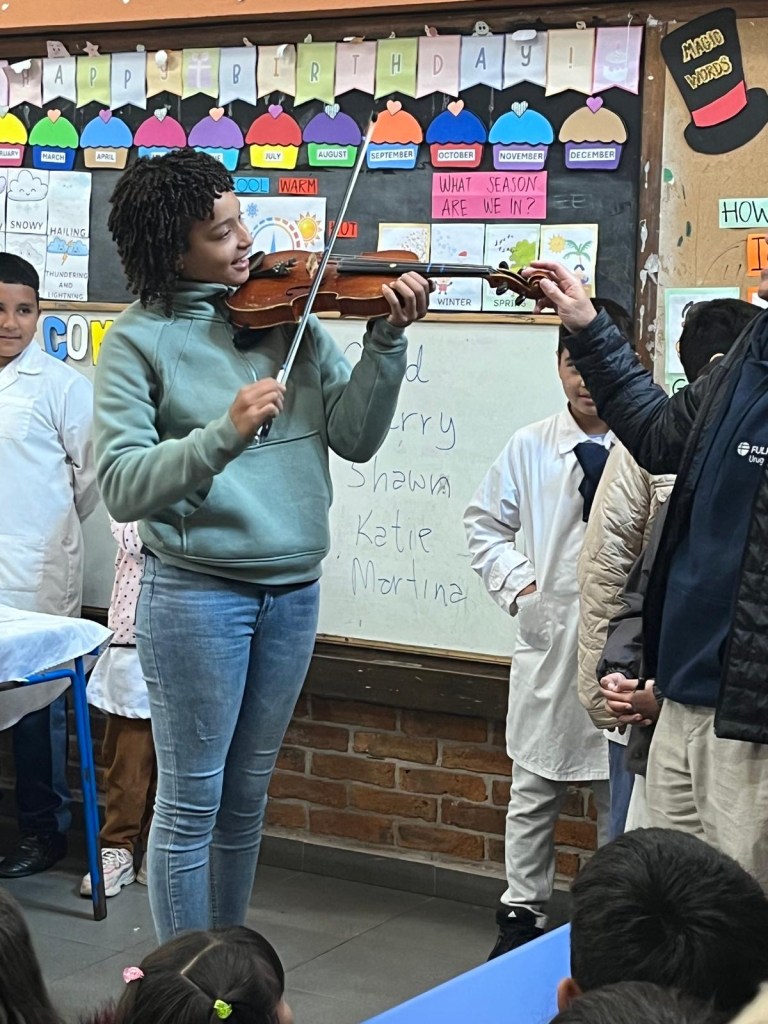
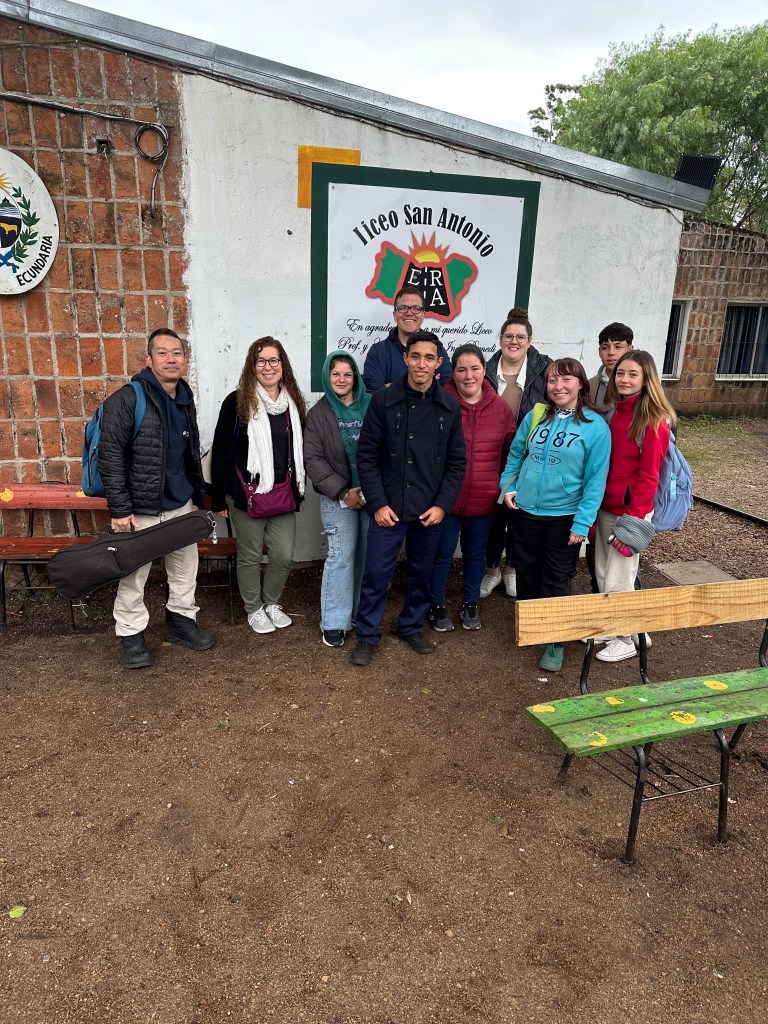
Far beyond what I expected, I got to play and teach the violin at almost all of the schools we visited. This experience was the highlight of my trip, and I’m so thankful for the opportunity. I wasn’t too nervous at the primary schools because it seems younger children, anywhere you go, tend to be fascinated by musicians and the instruments they play. This was the case in Uruguay where the younger students I met really seemed to enjoy watching me perform, listening to the sounds of the violin, and learning about the instrument. When I asked who wanted to try the instrument, many hands went up. I was not expecting the older students at the secondary school we visited to also take so enthusiastically to me and my performance, but they seemed to love what I had to offer. Like the younger kids, many wanted the chance to play the violin. I felt like a celebrity when so many students and teachers swarmed me for pix at the end. It’s fulfilling for me, knowing that I spread some joy and happiness through music.
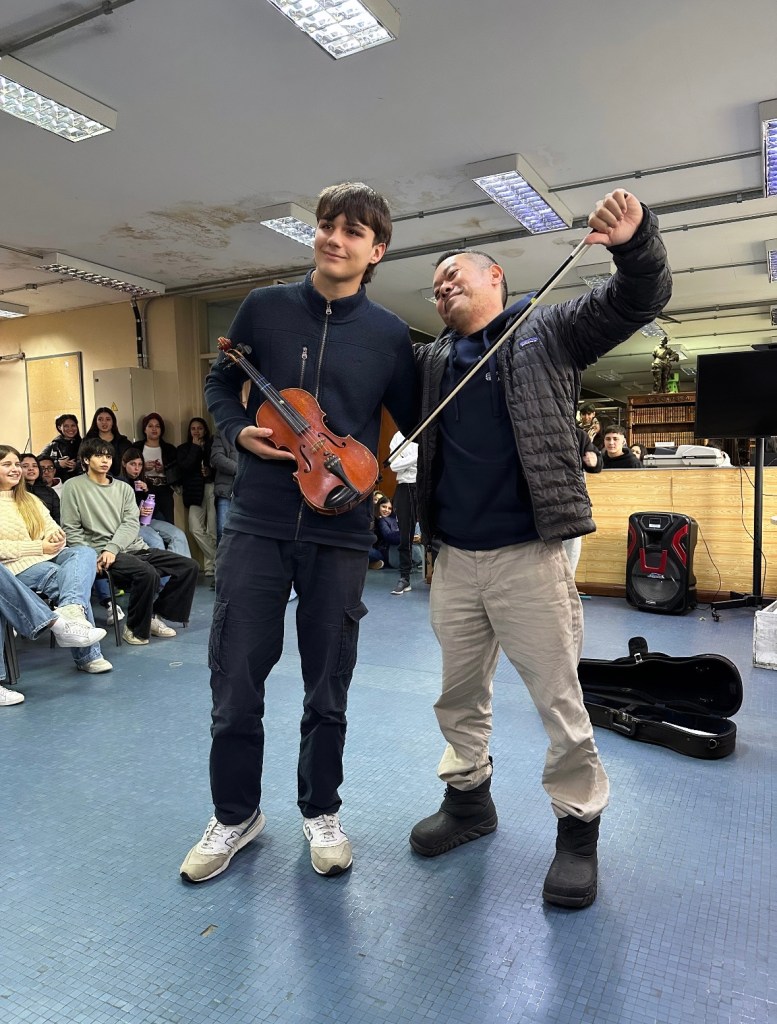
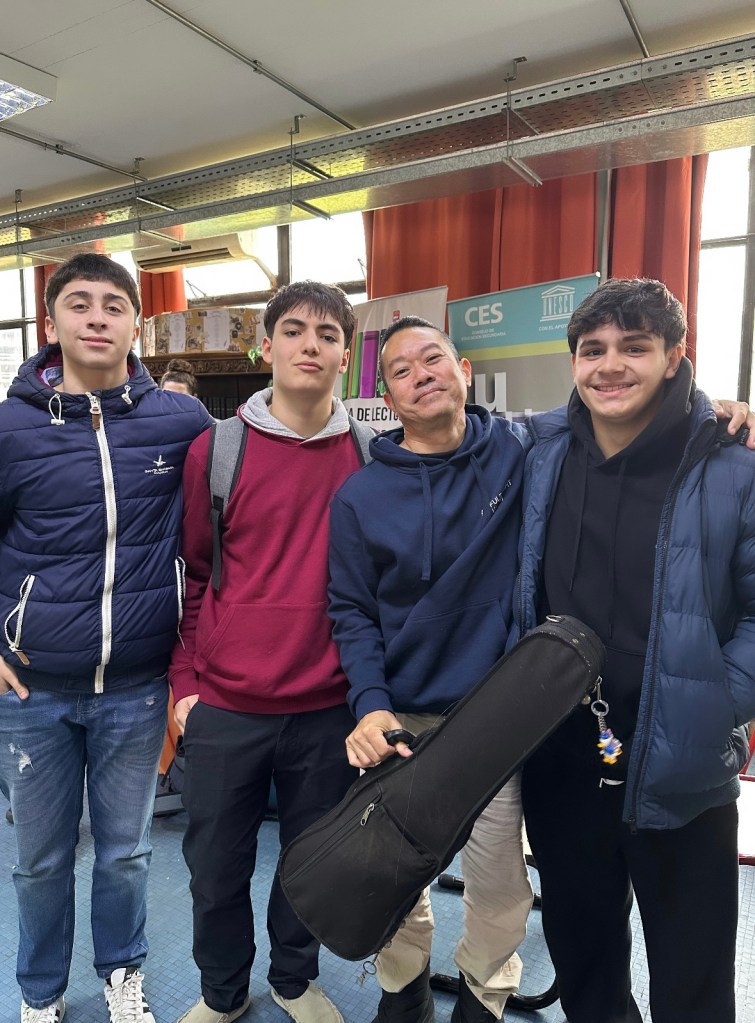
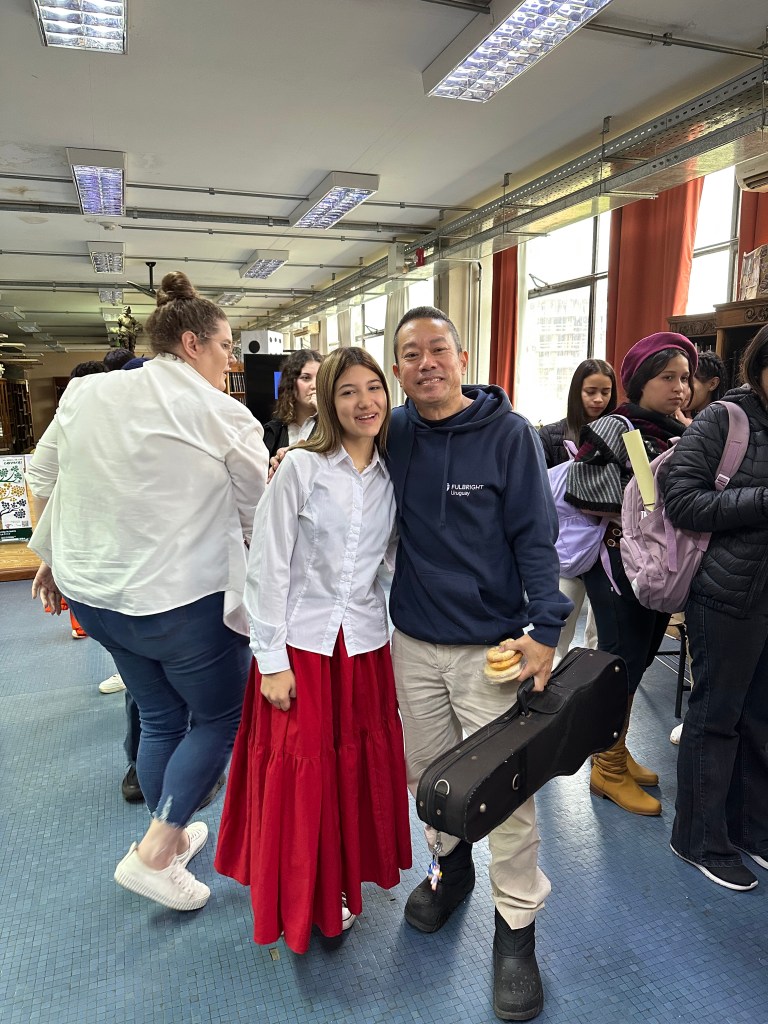
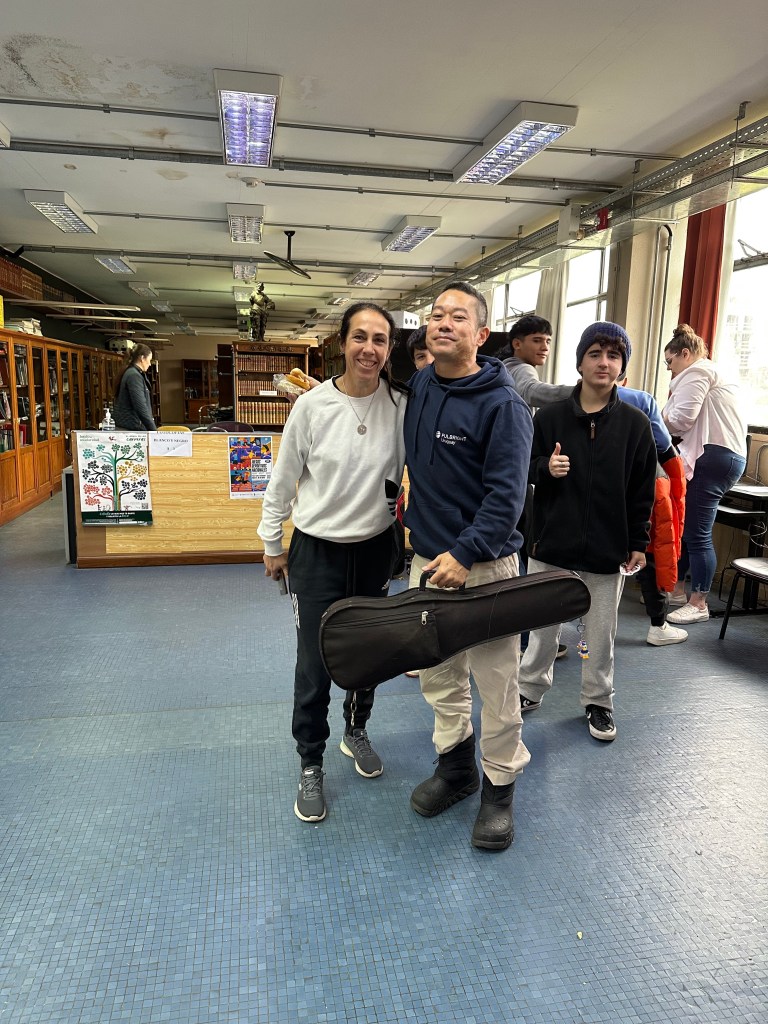
My Fulbright colleagues mentioned to me that how I taught the students to get a decent sound out of the violin made for a beautiful and positive experience. They also liked how I managed to capture everyone’s attention while performing, not just through the music, but through my stage presence. Realizing how receptive everyone was to me, to the music, and to learning the violin made me come to the conclusion that not only do people love music, but that they are willing to listen to what musicians want to communicate through their music and that they are open to new experiences such as playing an instrument. My Guiding Question’s inquiry into the value of music was once again addressed through these uplifting experiences in music performance and education.
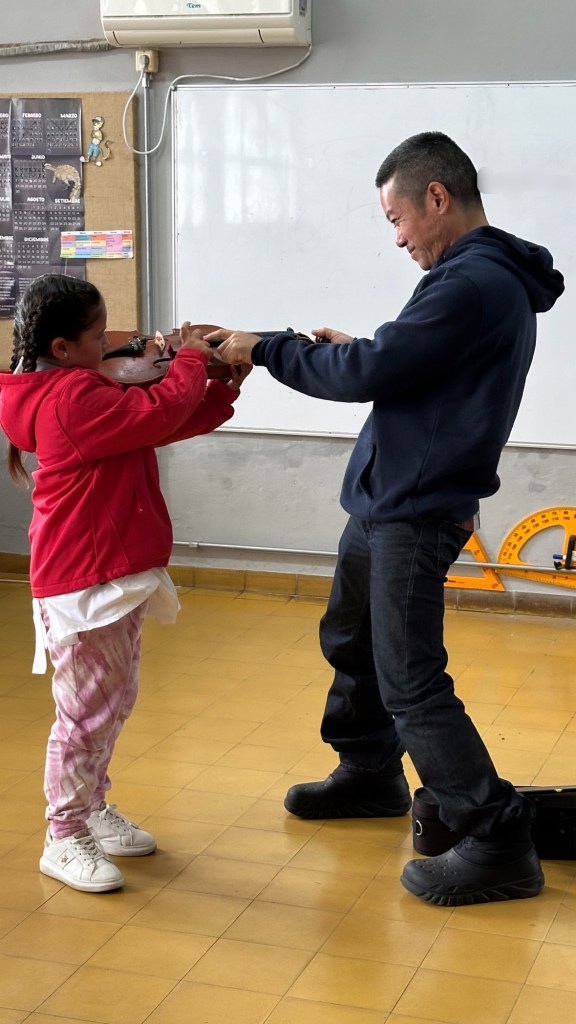
He was having a difficult time plucking the same string I did, however, I tried to keep going so that he would not get discouraged. Then again, maybe he wasn’t even trying to imitate me?
After music class, we often feel better. Music can turn around a bad day, and uplift our spirits.
Playing and teaching the violin in Uruguay also confirmed the idea of music as a universal language, which I had actually considered as a Guiding Question. When we play music, we do not need words. Their primary language is Spanish and mine English. I used only sound, movement, and non-verbal cues to teach the students in Uruguay the violin. Lots of laughter, learning, and love came out of those music lessons.
My Guiding Question not only sought to uncover how music is valued and appreciated in Uruguay, but also to what extent it is part of the school curriculum. Based on my school visits to a variety of public and private schools, at primary and secondary levels, in Motevideo and in Salto, morning classes for students in Uruguay consist of subjects like language, math, science, technology, and social studies. Afternoon classes at school or at specialized schools are offered in subjects like performing arts, visual arts, and athletics. While in Salto, I visited an elementary school of the arts where students are offered a wide variety of arts classes (see below).
In addition to playing violin for everyone and allowing kids to try it, I also got to observe a band and a dance class, played with the band on the tunes I knew, and learned basic movements and posture in the dance class. The band played one tune from Uruguay (posted below), with the rest of the music coming from America, including the tunes “Hit the Road Jack” and “Can’t Take My Eyes Off You.”
I’m too bouncy…hehe
The group who travelled to Minas went to a concert by music students studying at the Casa de Cultura. Below are videos from the concert they attended. I wonder it they play music from Uruguay? Like the music selections in the band class, music from Europe and the United States seems to be favored by this music director.
According to a member of the Minas group, the music students receive free music lessons at this cultural center twice a week. Practices and performances are held at the center. Classes in cooking, Candombe, photography, and a variety of other subjects are offered. If they don’t offer a subject, people can request it, and just need three other students to participate. There are classes for both children and adults. Every province has a Casa de Cultura in the capital city. As a music educator and musician, it’s comforting to see the existence of cultural centers such as the on in Minas and arts schools like the one I visited in Salto. I’m happy the arts are a valued in learning and education, and that programs in the arts are thriving with many students.
SODRE (Servicio Ofical de Difusión, Representaciones y Espectáculos) is a national cultural organization, run by the Ministry of Education and Culture, and yet another example of Uruguay’s commitment to preserving and perpetuating the performing arts. While in Montevideo, our whole cohort attended a performance of the musical Metrópolis, featuring SODRE’s Coro Nacional de Niños y Juvenil at the Auditorio Nacional Adela Reta. Every seat in the auditorium looked full, showing how much people support music and music education in Uruguay. The choirs are part of SODRE’s Elencos Estables, which also includes the Orquesta Juvenil Nacional, as well as the professional groups: Orquesta Sinfónica Nacional, Conjunto Nacional de Música de Cámara, Coro Nacional, and Ballet Nacional. Members in all these groups must audition for their spots.
SODRE also offers free training for students who want to embark on a professional career in the performing arts, with speciality schools in classical singing, ballet, modern dance, folklore, tango, and teacher training. The Uruguayan traditions of Candombe and Tango are mentioned as part of the folklore education. I did quite a bit of research on these two traditions prior to my field experience in Uruguay, reading about them on many websites, watching videos of Candombe and Tango performances and events, and listening to the music from these two artforms. I was hoping we would get to experience both Candombe and Tango in Uruguay, and that these experiences would help inform the response to my Guiding Question.
The visit to Africania Uruguay with a presentation – performance by Director Tomás Alberto Olivera Chirimini and the Conjunto Bantu was another highlight of my time in Uruguay. The drumming and dancing resonated deep within my soul, and it was inspiring to watch the performers who seemed so committed and invested in their work. Interesting, though, that this was the first time seeing black people who lived in Uruguay. I had watched Candombe videos when they announced my placement in Uruguay, and saw the Carnival parades filled with black people Candombe drumming and dancing in the streets. From these videos, I was expecting to see more black people, but this was not the case. Perhaps their population is higher in places we did not visit.
In addition to Candombe, Tango is often cited as another prominent Uruguayan tradition. I tried to learn Maria Millar’s solo violin arrangement of the famous Uruguayan tango “La Cumparsita,” in hopes of performing it during my field experience. I did not practice enough, though, and therefore did not have the confidence to share it in Uruguay. Upon returning back to Hawai‘i, I started practicing it regularly in hopes of someday performing it, and also to learn more about Tango violin and its tradition. I was a bit disappointed that we did not get to experience any Tango culture while in Uruguay, but I know we couldn’t do everything the country has to offer. Tango is definitely a music and dance genre I want to explore more. My students also seem to take to this genre with the tangos “Por una Cabeza” and “Libertango” having been chosen by student-driven chamber ensembles to learn and perform. Whatever style of music I am learning or teaching, I will definitely continue my Guiding Question’s inquiry into the extent music is practiced, taught, and valued in the culture.
While I am always on the lookout for travel programs that involve learning or teaching music, the Fulbright Teachers for Global Classrooms experience has prompted me to be more active in searching for programs that also promote global education and citizenship. I’m seriously considering the Daraja Music Initiative in Tanzania for summer 2026, however, my primary concern is travel safety to Africa. This program involves teaching violin, performing, learning about tree conservation and instrument making, and doing conservation work. It’s an in-depth world travel experience that brings together my interests in global citizenship, global education, music education, and music performance, going beyond touristy travel (although there are touristy activities like a safari).
I want to end this reflection with my thoughts on cellist Pablo Casals statement: “Perhaps it is music that will save the world.” I used this quote to frame my Global Education Presentation, one of the culminating projects to the online course component of this Fulbright program. I have also put it on the home page of this site. It is a reminder that we cannot deny our global issues, and that maybe creating something beautiful, such as music, rather than something destructive, is the solution. My fulfilling life in music and my Fulbright experience, especially the field experience in Uruguay, confirm that music and dance bring people together in so many beneficial ways, creating laughter, joy, and good vibes. While musicking and dancing may not directly solve the world’s problems, they stimulate mind, body, and soul, leading to collaboration, critical thinking, open minds, and open hearts – characteristics that we all need to improve life on this planet.
“Perhaps it is music that will save the world.”
— Pablo Casals
 Uyehara in Uruguay