When the terms “citizenship,” “education,” and “competency” are combined with the word “global” to form the terms “global citizenship,” “global education,” and “global competency,” they refer to the same values and actions, which I have distilled into a single definition here:
Global citizenship
— Chad Haruo Uyehara
Global education
Global competency
… prioritizes the well-being and sustainability of all life on earth and recognizes the uniqueness of the world’s cultures, but that our problems and globally interconnected, and values collaboration, communication, research, action, and empathy to create a better world.
Brandon Wiley: Six School-Wide Strategies to Globalize Your School
Great overview of globalism with lots of practical strategies. The thing that had the most impact was when he asked us to think of global competency as the plate upon which everything is served, rather than something added to the plate. Utilizing globalism as a mindset, rather than another thing we need to do makes the work a lot less overwhelming and can provide new ideas to improve our teaching and our students’ learning.
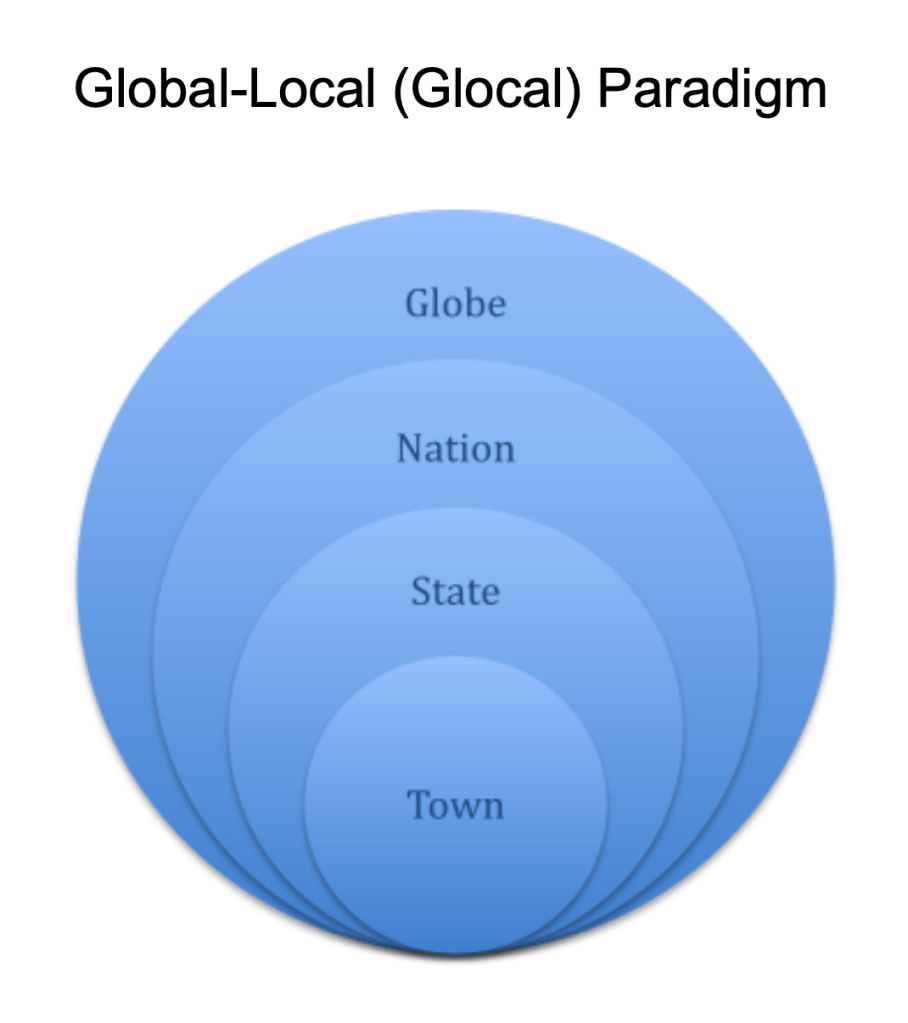
What about “glocal”?
Glocal is a combination of the words “global” and “local,” emphasizing the interconnection of the two realms, as well as the various communities that shape our thinking, values, and actions.
— Chad Haruo Uyehara
Don’t Ask Me Where I’m From, Ask Me Where I’m Local
by Taiye Selasi
What makes us who we are is more than the nation from which we come, but our life experiences and the specific places in which they occur. We can use a three step test to examine our identities:
- Rituals: Daily things like making coffee, driving car, taking shoes off at home
- Relationships: People who shape your weekly emotional experience; relationships feel like home
- Restrictions: Where are you able to live; what passport do you hold; restricted by racism, civil war, economic inflation
We are all multi-layered and multi-local, and acknowledging our complexities can bring us closer together. We need to move beyond stereotypes that nationalism and prejudice can sometimes foster. My students were competing in Florida, and were called “stupid Hawaiians” by kids from another competing school. Part of my mission as a music educator who enjoys traveling is to show the world the high quality music programs, students, and teachers we have here, and that we have much to share and to offer.
 Uyehara in Uruguay